

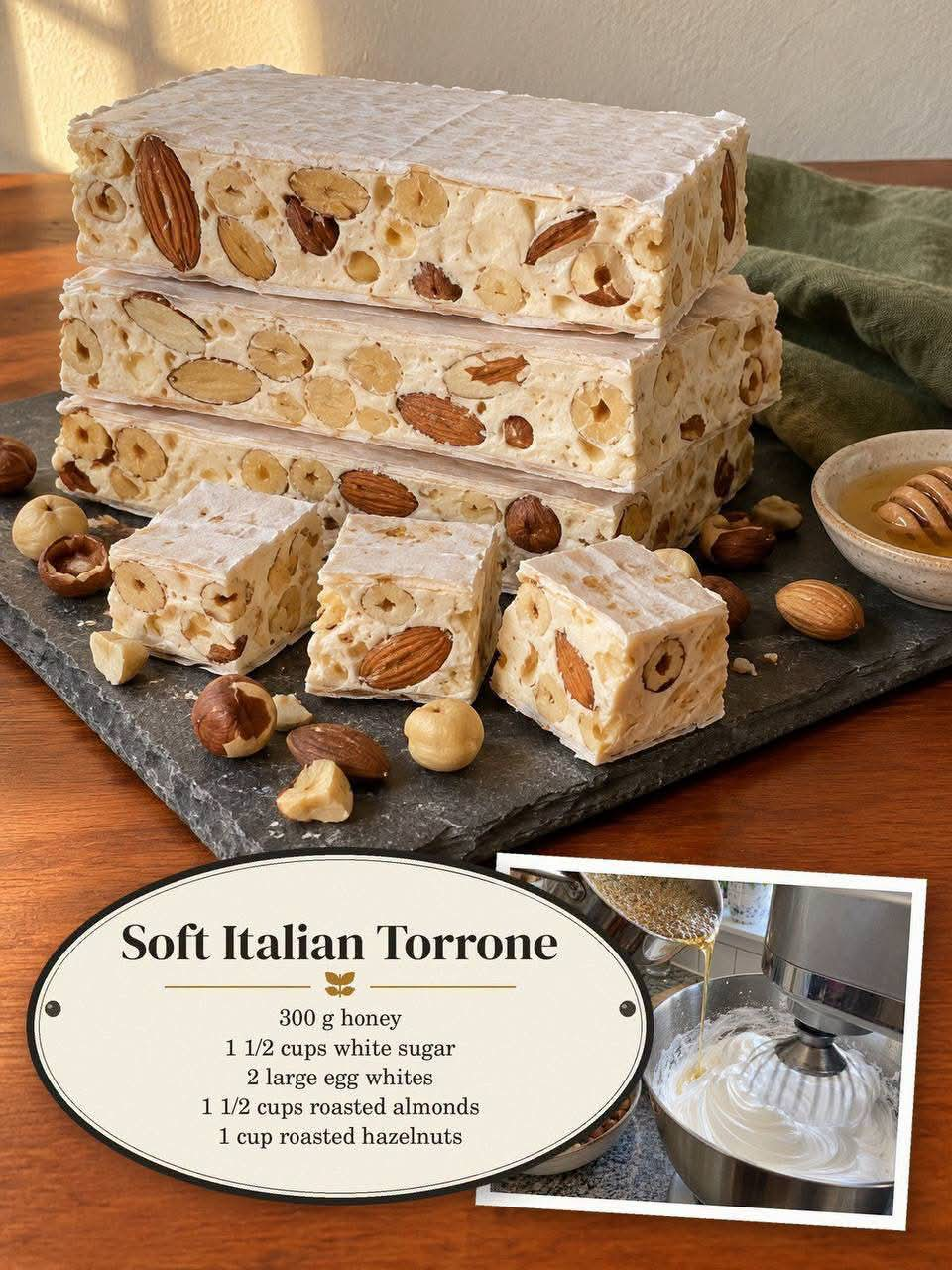
Soft Italian Torrone is a traditional Italian nougat candy made with honey, sugar, egg whites, and a generous combination of toasted almonds and pistachios. This classic confection has a beautiful ivory color, a chewy texture, and a delicate sweetness that makes it especially popular during Christmas and other holiday celebrations.
Unlike hard, brittle nougat, this homemade Italian torrone is tender and chewy, with crunchy nuts in every bite. Thin sheets of edible wafer paper keep the nougat from sticking and give the finished bars their traditional appearance.
Although torrone takes patience and careful temperature control, making it at home is a rewarding way to create a special holiday treat. Slice it into bars or bite-sized pieces and serve it with coffee, tea, or a dessert platter.
Why You’ll Love This Italian Torrone
- Traditional Italian flavor: Honey, toasted nuts, and vanilla create a classic combination.
- Soft and chewy texture: Whipped egg whites help create the characteristic light nougat interior.
- Packed with nuts: Almonds and pistachios provide crunch and rich flavor in every piece.
- Perfect for holidays: Torrone is a wonderful addition to Christmas candy trays and homemade edible gifts.
- Make-ahead friendly: The nougat rests overnight before slicing, making it convenient to prepare ahead.
- Customizable: You can experiment with hazelnuts, citrus zest, candied orange peel, or chocolate-dipped ends.
Ingredients You’ll Need
Honey: Honey gives torrone its signature sweetness and distinctive flavor. Choose a honey you enjoy tasting on its own because it plays a major role in the finished candy.
Granulated sugar: Sugar provides structure and sweetness while helping the nougat set.
Glucose syrup or light corn syrup: This ingredient helps limit sugar crystallization, encouraging a smoother texture.
Water: Water dissolves the sugar before the syrup reaches its required temperature.
Egg whites: Whipped egg whites give the nougat its pale color and characteristic chewy structure. Pasteurized egg whites can be used if they are suitable for whipping.
Fine salt: A small pinch balances the sweetness.
Vanilla extract: Vanilla adds warmth and rounds out the honey flavor.
Whole raw almonds: Toasted almonds provide a rich, nutty flavor and a satisfying crunch.
Shelled pistachios: Pistachios add a delicate flavor and attractive green color.
Edible wafer paper: Two sheets help prevent sticking and give the torrone its traditional finish. Use wafer paper specifically intended for confectionery.
Neutral oil: A small amount helps prevent the spatula, knife, and hands from sticking to the nougat.
How to Make Soft Italian Torrone
Step 1: Toast the Nuts
Preheat the oven to 325°F (160°C). Spread the almonds on a baking sheet and toast them for 10 to 12 minutes. Add the pistachios for the final 6 to 7 minutes.
Watch the nuts carefully so they do not burn. Once toasted, reduce the oven temperature to 200°F (95°C) and keep the nuts warm inside. Warm nuts are easier to incorporate because they help prevent the nougat from stiffening too quickly.
Step 2: Prepare the Pan
Line the bottom of an 8-by-8-inch square pan with one sheet of edible wafer paper. Trim the sheet if necessary so it fits neatly.
Keep the second sheet nearby for the top of the nougat. Lightly oil a silicone spatula and prepare a clean work surface before cooking the syrups, since the mixture will become difficult to handle as it cools.
Step 3: Heat the Honey
Pour the honey into a large, heavy-bottomed saucepan fitted with a candy thermometer. Heat over medium heat, stirring occasionally, until it reaches 250°F (121°C).
Honey can foam and expand significantly as it heats, so use a saucepan with plenty of room. Avoid leaning over the pan or allowing the hot honey to splash.
Step 4: Cook the Sugar Syrup
In a second heavy-bottomed saucepan, combine the granulated sugar, glucose syrup, and water.
Heat over medium heat, stirring until the sugar dissolves. Once the mixture begins boiling, stop stirring and allow it to reach 300°F (149°C), the hard-crack stage.
Use a reliable candy thermometer to monitor the temperature. Hot sugar syrup can cause severe burns, so handle it carefully and keep children and pets away from the cooking area.
Step 5: Whip the Egg Whites
When the honey approaches 235°F (113°C), place the egg whites and a pinch of salt in the bowl of a stand mixer fitted with a whisk attachment.
Whip on medium-high speed until stiff peaks form. The egg whites should be ready just as the honey reaches its target temperature.
Step 6: Add the Hot Honey
With the mixer running on medium speed, slowly pour the hot honey into the whipped egg whites in a thin, steady stream down the side of the bowl.
Avoid pouring directly onto the whisk, as this can cause hot honey to splatter. The mixture will expand and become pale, glossy, and fluffy.
Step 7: Add the Sugar Syrup
As soon as the sugar syrup reaches 300°F (149°C), carefully pour it into the egg-white mixture in the same slow, steady manner.
Increase the mixer speed to high and whip for approximately 8 to 10 minutes, until the nougat becomes thick and more matte in appearance. It should fall from the whisk in heavy ribbons that hold their shape.
The mixture will be extremely hot, so keep hands and utensils away from the syrup stream.
Step 8: Add the Vanilla and Nuts
Stop the mixer and stir in the vanilla extract. Using an oiled spatula, quickly fold in the warm almonds and pistachios until they are evenly distributed.
Work efficiently because the nougat begins to stiffen as it cools. Make sure the nuts are spread throughout the mixture rather than concentrated in one area.
Step 9: Press the Nougat Into the Pan
Transfer the nougat to the prepared pan. Using an oiled spatula or lightly oiled hands, carefully press it into the corners and smooth the surface.
Place the second sheet of edible wafer paper on top. Press gently to help it adhere to the nougat.
Step 10: Rest Until Firm
Place a flat board over the nougat and add a light weight, such as a couple of cans, to help keep the surface level.
Allow the torrone to rest at room temperature for 12 to 24 hours in a cool, dry place. Avoid refrigerating it, as condensation can make the surface sticky.
Step 11: Slice and Serve
Turn the set nougat onto a cutting board. Lightly oil a long, sharp knife and cut the slab into four strips, then cut each strip into four bars to make approximately 16 pieces.
Wipe and re-oil the knife as needed to prevent sticking. Serve the torrone at room temperature with coffee or tea, or arrange the bars on a holiday dessert platter.
Tips for Perfect Homemade Torrone
Use a candy thermometer. Accurate temperatures are essential for achieving the right consistency. If the honey or sugar syrup is not heated sufficiently, the nougat may remain sticky or fail to hold its shape.
Check your thermometer. A thermometer that reads inaccurately can affect the result. Check it in boiling water and account for your altitude and local boiling point when necessary.
Keep the nuts warm. Cold nuts can cause the nougat to stiffen before you have time to spread it evenly.
Prepare everything beforehand. Have the pan lined, wafer paper ready, utensils lightly oiled, and nuts toasted before you begin whipping the egg whites.
Work quickly after adding the nuts. The mixture becomes firmer as it cools, so transfer and press it into the pan promptly.
Choose a dry day if possible. Sugar attracts moisture from the air, and high humidity can leave homemade nougat tacky.
Use a large, sturdy saucepan. Honey foams as it heats, and the sugar syrup reaches a very high temperature. Heavy-bottomed pans and adequate headspace help make the process easier to manage.
Cut with an oiled knife. Torrone can cling to the blade. Lightly oiling the knife and cleaning it between cuts helps produce neater bars.
Delicious Variations
Hazelnut Torrone
Replace the almonds and pistachios with approximately 350 grams of toasted hazelnuts for a rich, classic variation. Toast the hazelnuts until fragrant and remove loose skins before adding them to the nougat.
Citrus Torrone
Add finely grated orange or lemon zest along with the vanilla. Citrus adds freshness that complements the honey and nuts.
Chocolate-Dipped Torrone
Once the bars have been cut, dip the ends into melted dark chocolate. Place them on parchment paper and let the chocolate set before serving or wrapping.
Candied Orange Torrone
Fold approximately 80 grams of finely chopped candied orange peel into the nougat with the nuts. This variation adds a sweet citrus flavor and a festive appearance.
Mixed-Nut Torrone
Use a combination of almonds, pistachios, and hazelnuts while keeping the total amount of nuts close to the original quantity. Toast each variety appropriately before mixing it into the warm nougat.
How to Serve Italian Torrone
Italian torrone is delicious on its own, but it can also be part of a larger holiday dessert spread.
Serve it with:
- Espresso or freshly brewed coffee
- Black tea or herbal tea
- Christmas cookies and homemade candies
- A holiday dessert platter with dried fruit and nuts
- Small squares of dark chocolate
- Homemade edible gift boxes
Because torrone is rich and sweet, cutting it into smaller bars or bite-sized pieces makes it easy to serve after a large meal.
How to Store Homemade Torrone
Room temperature: Wrap individual bars in parchment or wax paper and store them in an airtight container in a cool, dry place. The original recipe recommends keeping them for up to four weeks, although actual shelf life depends on preparation, humidity, and storage conditions.
Refrigerator: Refrigeration is generally not recommended because condensation can make the nougat sticky.
Freezer: For longer storage, wrap the bars well and freeze for up to three months. Thaw them in their sealed container to reduce condensation on the surface.
Keep torrone away from heat and humidity, and avoid storing it alongside foods with strong odors.
Frequently Asked Questions
What is Italian torrone?
Italian torrone is a traditional nougat confection made with honey, sugar, egg whites, and nuts. Many varieties are enclosed between thin sheets of edible wafer paper. It can be soft and chewy or firm and crunchy, depending on the recipe and cooking method.
Is torrone supposed to be soft or hard?
Both styles are traditional. This recipe makes soft, chewy torrone with a pale nougat interior and crunchy nuts. Hard torrone is prepared differently and develops a brittle texture.
Do I need a candy thermometer?
Yes. A candy thermometer is strongly recommended for this recipe because the honey and sugar syrup must reach specific temperatures for the nougat to set properly.
Why is my torrone sticky?
Sticky torrone may result from undercooked honey or sugar syrup, high humidity, or insufficient resting time. Check the thermometer’s accuracy and make sure both mixtures reach their target temperatures.
Why did my torrone become too hard?
The sugar syrup may have exceeded the intended temperature, or the mixture may have cooled before it was pressed into the pan. Accurate temperature control and quick handling help produce the desired chewy texture.
Can I make torrone without wafer paper?
Yes. You can line the pan with lightly oiled parchment paper instead. The wafer paper is traditional, but parchment can help prevent sticking when edible wafer paper is unavailable.
Can I use different nuts?
Yes. Hazelnuts, almonds, pistachios, and other suitable nuts can be used. Keep the total amount close to the recipe’s quantity and toast the nuts before adding them.
How long does torrone need to rest?
Allow it to rest for 12 to 24 hours at room temperature in a cool, dry place. This gives the nougat time to firm up so it can be cut into bars.
Can I make Italian torrone ahead of Christmas?
Yes. Torrone is an excellent make-ahead holiday candy. Once it has rested and been sliced, wrap the pieces individually and store them in an airtight container in a cool, dry place.
Soft Italian Torrone Recipe Card
Prep Time: Approximately 40 minutes active preparation
Cook Time: Approximately 30–40 minutes, depending on heating and mixing
Resting Time: 12–24 hours
Total Time: Approximately 13–25 hours
Yield: 16 bars
Ingredients
- 300 g honey (about 7/8 cup)
- 300 g granulated sugar (1 1/2 cups)
- 100 g glucose syrup or light corn syrup (about 1/3 cup)
- 75 ml water (about 1/3 cup)
- 2 large egg whites (about 60 g), at room temperature
- 1 pinch fine salt
- 1 teaspoon vanilla extract
- 225 g whole raw almonds (about 1 1/2 cups)
- 125 g shelled raw pistachios (about 1 cup)
- 2 sheets edible wafer paper, each about 8 x 8 inches (20 x 20 cm)
- Neutral oil, for the knife, spatula, and hands
Instructions
- Preheat the oven to 325°F (160°C). Toast the almonds for 10–12 minutes, adding the pistachios for the final 6–7 minutes. Reduce the oven temperature to 200°F (95°C) and keep the nuts warm.
- Line the bottom of an 8-by-8-inch pan with one sheet of edible wafer paper.
- Heat the honey in a large, heavy-bottomed saucepan until it reaches 250°F (121°C).
- In a separate saucepan, combine the sugar, glucose syrup, and water. Stir until the sugar dissolves, then boil without stirring until the syrup reaches 300°F (149°C).
- When the honey approaches 235°F (113°C), whip the egg whites and salt in a stand mixer until stiff peaks form.
- With the mixer running on medium speed, slowly pour the hot honey into the egg whites in a thin stream.
- Carefully add the sugar syrup in a slow, steady stream once it reaches 300°F (149°C). Whip on high speed for 8–10 minutes, until the nougat is thick and holds its shape.
- Stop the mixer and stir in the vanilla extract. Quickly fold in the warm almonds and pistachios using an oiled spatula.
- Transfer the nougat to the prepared pan and press it evenly into the corners. Cover with the second wafer sheet.
- Place a flat board on top with a light weight and let rest at room temperature for 12–24 hours.
- Turn the nougat onto a cutting board and use a lightly oiled knife to cut it into approximately 16 bars.
- Wrap or serve the bars, storing any leftovers in an airtight container in a cool, dry place.
Final Thoughts
Soft Italian Torrone is a timeless homemade candy that brings together honey, toasted nuts, and a beautifully chewy nougat texture. Although it requires careful temperature control and a little patience, the result is a special treat worthy of holiday celebrations and homemade gifts.
Prepare the ingredients in advance, use a reliable candy thermometer, and let the nougat rest fully before slicing. Serve the finished bars with coffee or tea, or share them with friends and family as a delicious taste of Italian holiday tradition.